
February 6, 2008


February 5, 2008
India, Part 2 - Culture Shock
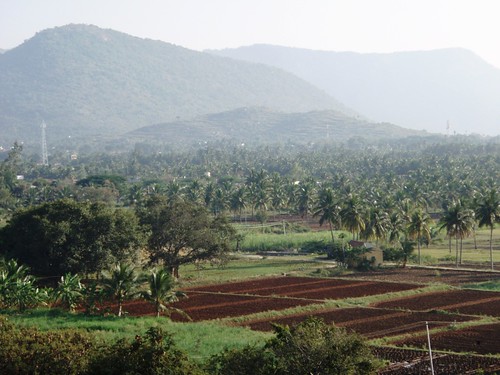
There were a number of things about our arrival in Bangalore and the subsequent drive to the school that shocked me more than I, at the time, was willing to admit. Upon our arrival, however, the thing that did not shock me was that British Airways lost one of Richard's bags. That the rest of us made it with ours all in one piece is, I suppose, modestly shocking, but since that's the job of an airline, it barely deserves an honorable mention.
Upon retrieving our bags, we all waited in a big clump for Richard to fill out the appropriate forms. I noticed a bathroom, and after asking Steph to guard my stuff, I ran in to put my contacts in; I didn't want to miss any of the trip out to Salem because I couldn't see anything. But as I started putting them in - wash my fingers in some saline (don't use the tap water!), remove contact from case, insert - I noticed, out of the corner of my eye, a guy staring at me.
It was to be a pattern the rest of our trip.
That's what Indians do when white people go past them - they stare. I say this in the most loving way possible, because they don't see white people as often as you might think. We in the west have it pretty cozy, and while we might think that we have racial troubles, India barely even has "diversity" (and what diversity it has is along religious lines rather than racial). As far as the eye can see, dark skin, dark hair, dark eyes. And I really do mean "as far as the eye can see" - India is the size of Texas but has a population around 1.1 billion and growing. So to see a patch of white skin is a bit shocking, never mind the occasional blonde or redhead. Anyway, he stared at me as I put in my contacts, and as I finished, though I was completely wierded out by this, I turned to him and said "better than glasses" and walked out of the restroom.
Seriously. I don't know what I was thinking.
It was along the drive that I began making generalizations about the environment around me. For one, I was shocked at the sheer amount of rubble laying everywhere. Nearly the entire route out of the city was under construction of some form or another, and looked like it had been that way for many, many years. Housing lots sat, useless, heaped with piles of old bricks and garbage. Once we were out of the city, it wasn't a whole lot better; even along country roadsides, there were plenty of brick piles, stone piles, and endless fields of garbage in and around the rocks and shrubbery.
I think that was the hardest part - the garbage. The way Indians took care (or didn't) of their chunk of dirt was disheartening, enough to make any staunch environmentalist from the west keel over in shock. If that wasn't bad enough, those that did want to dispose of their garbage in a manner not involving kinetic motion did so by burning it in large piles, the dark smoke lazily drifting across the countryside. I think most of us suffered, if only mildly (though some hard a lot of trouble), from allergies due to this smoke through the trip. I mean, I'm upset that our apartment complex doesn't have recycling bins available, but this was way above and beyond.
But on the bright side, it did make for some spectacular sunsets.
 There was one day when I got a chance to see that sunset from above the treetops. There's a place we called the "watchtower," though it was actually a five-story apartment tower around a staircase, which was the tallest thing around, and the only building that rose above the level of the surrounding trees. It just so happened to have an observation deck at the top, accessable by four flights of stiars and two ladders. Dr. Martyn and I had walked up to the top on our way back from delivering Dr. Keith and some supplies to the hospital several days earlier, and tonight I'd decided to gather a few of the team and we all got up there together to watch the sun go down.
It was absolutely beautiful. While the pictures taken by our cameras that night may look nice, they were nothing in comparison to actually being there. I stick to my statement from last post about the country looking better from above; the garbage fires had all burned out for the evening, the birds had settled down (and so it was fairly quiet), a cool breeze was stirring the moderately humid air, and all was well. The sun sank into the horizon, and as dusk settled over the treetops, we made the trek down the stairs and headed back to our dorms to get some sleep; we had to get up early again for chapel in the morning.
Upon retrieving our bags, we all waited in a big clump for Richard to fill out the appropriate forms. I noticed a bathroom, and after asking Steph to guard my stuff, I ran in to put my contacts in; I didn't want to miss any of the trip out to Salem because I couldn't see anything. But as I started putting them in - wash my fingers in some saline (don't use the tap water!), remove contact from case, insert - I noticed, out of the corner of my eye, a guy staring at me.
It was to be a pattern the rest of our trip.
That's what Indians do when white people go past them - they stare. I say this in the most loving way possible, because they don't see white people as often as you might think. We in the west have it pretty cozy, and while we might think that we have racial troubles, India barely even has "diversity" (and what diversity it has is along religious lines rather than racial). As far as the eye can see, dark skin, dark hair, dark eyes. And I really do mean "as far as the eye can see" - India is the size of Texas but has a population around 1.1 billion and growing. So to see a patch of white skin is a bit shocking, never mind the occasional blonde or redhead. Anyway, he stared at me as I put in my contacts, and as I finished, though I was completely wierded out by this, I turned to him and said "better than glasses" and walked out of the restroom.
Seriously. I don't know what I was thinking.
It was along the drive that I began making generalizations about the environment around me. For one, I was shocked at the sheer amount of rubble laying everywhere. Nearly the entire route out of the city was under construction of some form or another, and looked like it had been that way for many, many years. Housing lots sat, useless, heaped with piles of old bricks and garbage. Once we were out of the city, it wasn't a whole lot better; even along country roadsides, there were plenty of brick piles, stone piles, and endless fields of garbage in and around the rocks and shrubbery.
I think that was the hardest part - the garbage. The way Indians took care (or didn't) of their chunk of dirt was disheartening, enough to make any staunch environmentalist from the west keel over in shock. If that wasn't bad enough, those that did want to dispose of their garbage in a manner not involving kinetic motion did so by burning it in large piles, the dark smoke lazily drifting across the countryside. I think most of us suffered, if only mildly (though some hard a lot of trouble), from allergies due to this smoke through the trip. I mean, I'm upset that our apartment complex doesn't have recycling bins available, but this was way above and beyond.
But on the bright side, it did make for some spectacular sunsets.
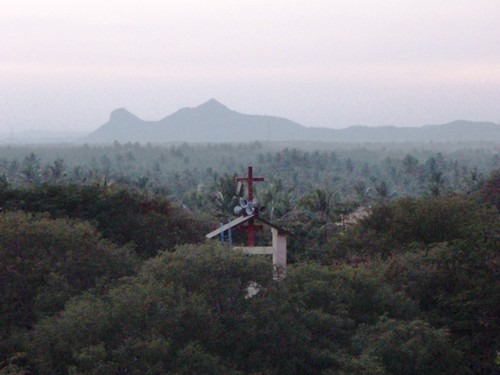 There was one day when I got a chance to see that sunset from above the treetops. There's a place we called the "watchtower," though it was actually a five-story apartment tower around a staircase, which was the tallest thing around, and the only building that rose above the level of the surrounding trees. It just so happened to have an observation deck at the top, accessable by four flights of stiars and two ladders. Dr. Martyn and I had walked up to the top on our way back from delivering Dr. Keith and some supplies to the hospital several days earlier, and tonight I'd decided to gather a few of the team and we all got up there together to watch the sun go down.
It was absolutely beautiful. While the pictures taken by our cameras that night may look nice, they were nothing in comparison to actually being there. I stick to my statement from last post about the country looking better from above; the garbage fires had all burned out for the evening, the birds had settled down (and so it was fairly quiet), a cool breeze was stirring the moderately humid air, and all was well. The sun sank into the horizon, and as dusk settled over the treetops, we made the trek down the stairs and headed back to our dorms to get some sleep; we had to get up early again for chapel in the morning.
(to be continued ...)
January 26, 2008
India, Part 1
A city looks best from the sky, especially at night, when darkness erases every blemish. As our flight circled into the single-runway airport of Bangalore, I couldn’t help but notice that the sea of lights below our 747, an ocean of pale-orange brilliance glowing in the early-morning sky, obscured only by the wing of the plane and a few wisps of cloud. That I was able to notice all this is no small thing; not twelve hours earlier, on our previous flight, I was immobilized in my chair in coach, my head soaked in sweat as I reeled from vertigo due to a bout of turbulence. It was not a pleasant flight from there to London, but thanks to the Dramamine and Pepto-Bismol that my colleagues supplied, along with some short cat-naps in the London airport, I managed to make it through the successive ten-hour flight virtually vertigo-free.
However, for the first several days in India, I still felt as though I was viewing my life in the third-person, an inaudible buzz still permeating my thoughts. This was, of course, no thanks to the drive from the airport to Bethel. Indian driving is best compared to a car-chase scene from an action movie; signs, stoplights, and the road-level stripes seem to be merely suggestions rather than rules to be obeyed, and the other cars on the road are merely moving obstructions to be avoided (as fast as possible despite bumpy roads) rather than potential accidents. To a fragile stomach attempting to overcome his vertigo, this was not helpful. Most of my memories from this time are a cacophony of sounds, smells, and colors, punctuated by the occasional piece of Indian music.
By Monday, however, this mental fog had all but cleared away. It was a good thing, because it was Monday night that set the tone for the rest of my week. The team was asked to make house visits that night to the various dorms of Bethel students, but because of the growing number of victims to a vicious upper-GI bug, leadership basically said that whoever was awake enough could go, but the rest of us should rest. I nearly stayed to rest, as jet lag began to take hold. Dale, however, had other ideas. When the call came for some of us to go, he asked if I’d come to Jerusalem house with him to visit the teenage boys. Since otherwise he would’ve gone alone, I decided to join him and forgo a short nap. On the way out the door, I grabbed my Bible, noticing that Dale had forgotten his.
The Jerusalem boys greeted us with a level of enthusiasm I hadn’t expected, even for boys their age. They gave us a brief tour of their home (Spartan though it was), and it was at this moment that Dale informed me that I’d be sharing a message from scripture. It was also at this moment that I began to panic. I’ve never been very eloquent, and it is because of this that I have kept a personal rule: don’t speak unless prepared. I suppose this is why I enjoy my writing so much; it gives me an outlet for the many ideas romping around in my head.
They brought us into a large room, placed us each in a chair, and sat on the floor opposite us in neat, tidy rows, their dark eyes looking at us expectantly. Dale introduced himself, and told a little bit about where he’s from. I flipped through my bible, desperate for a story or some direction. Dale introduced me, and I stood up and told a bit about my family. Then I sat down, and as the boys sang us a song (about being a big happy family), I continued to panic, flipping through my bible, wishing I had more warning. Dale, noticing, leaned over to me and said “Chris, stop, close your Bible, and ask God what He wants to say through you tonight.”
It’s not as if I hadn’t thought of God in all this. I’d been whispering panicked prayers to him the entire time. But, as Dale reminded me, I’d forgotten to listen. It was when I began listening that an idea began to take form in my mind. I noticed the singing, and I began to mentally take notes, writing ideas down on mental paper. I opened my Bible to John 1, and began to talk about the Song of God to His creation. Our translator, bless his heart, had to interpret at times. I know this because I’d say a short sentence, but he’d ramble on in Tamil far longer than should have been necessary.
I think I got it close. There came a point, though, that I suddenly realized I had nothing more to say. Rather than ruin it with more words, I decided to forgo any sort of eloquent ending and just said, “nandri,” and sat down. Dale then got up to pray for the kids. Apparently, God had revealed several in particular to pray for; a Hindi boy, a boy who’d be going into ministry, one of the caretakers with epilepsy. It was around this time that a small boy began to tug at the leg of my Khakis, and as I leaned down, he asked (in his broken English and thick accent) if we’d pray for his “weak subject,” science. Once I’d asked Dale to pray for him, one of the caretakers informed us that he was from a broken family, his parents divorced and separated. Dale immediately began praying for him, that he’d know that he was not defined by these issues, that he is a loved child of God and that his family at Bethel loves him very much. After the prayer, something was nagging at me, like we hadn’t answered the question. Without really knowing I was doing it, I raised my hand and said that I had something to say.
“This boy has told us that science is his weak subject,” I said, “but there are many here who are not weak in science. You who are here are his family; those who are not weak in science could help him, just as he has gifts to offer to all of you! As a family, you must all work together, and together you will all succeed.”
They nodded. Dale looked surprised. I felt a bit embarrassed. But it had been the right thing to say; I just knew it.
On the way home, Dale told me how proud of me he was, how giddy he was that I’d listened to what God was telling me, how good God is. Earlier in the week, I had mentioned that I felt somewhat useless after chapel in the mornings; my one gift, I felt, was music – I had little else to offer once we sat down to breakfast. Dale chided me for it as we walked home, all smiles.
However, for the first several days in India, I still felt as though I was viewing my life in the third-person, an inaudible buzz still permeating my thoughts. This was, of course, no thanks to the drive from the airport to Bethel. Indian driving is best compared to a car-chase scene from an action movie; signs, stoplights, and the road-level stripes seem to be merely suggestions rather than rules to be obeyed, and the other cars on the road are merely moving obstructions to be avoided (as fast as possible despite bumpy roads) rather than potential accidents. To a fragile stomach attempting to overcome his vertigo, this was not helpful. Most of my memories from this time are a cacophony of sounds, smells, and colors, punctuated by the occasional piece of Indian music.
By Monday, however, this mental fog had all but cleared away. It was a good thing, because it was Monday night that set the tone for the rest of my week. The team was asked to make house visits that night to the various dorms of Bethel students, but because of the growing number of victims to a vicious upper-GI bug, leadership basically said that whoever was awake enough could go, but the rest of us should rest. I nearly stayed to rest, as jet lag began to take hold. Dale, however, had other ideas. When the call came for some of us to go, he asked if I’d come to Jerusalem house with him to visit the teenage boys. Since otherwise he would’ve gone alone, I decided to join him and forgo a short nap. On the way out the door, I grabbed my Bible, noticing that Dale had forgotten his.
The Jerusalem boys greeted us with a level of enthusiasm I hadn’t expected, even for boys their age. They gave us a brief tour of their home (Spartan though it was), and it was at this moment that Dale informed me that I’d be sharing a message from scripture. It was also at this moment that I began to panic. I’ve never been very eloquent, and it is because of this that I have kept a personal rule: don’t speak unless prepared. I suppose this is why I enjoy my writing so much; it gives me an outlet for the many ideas romping around in my head.
They brought us into a large room, placed us each in a chair, and sat on the floor opposite us in neat, tidy rows, their dark eyes looking at us expectantly. Dale introduced himself, and told a little bit about where he’s from. I flipped through my bible, desperate for a story or some direction. Dale introduced me, and I stood up and told a bit about my family. Then I sat down, and as the boys sang us a song (about being a big happy family), I continued to panic, flipping through my bible, wishing I had more warning. Dale, noticing, leaned over to me and said “Chris, stop, close your Bible, and ask God what He wants to say through you tonight.”
It’s not as if I hadn’t thought of God in all this. I’d been whispering panicked prayers to him the entire time. But, as Dale reminded me, I’d forgotten to listen. It was when I began listening that an idea began to take form in my mind. I noticed the singing, and I began to mentally take notes, writing ideas down on mental paper. I opened my Bible to John 1, and began to talk about the Song of God to His creation. Our translator, bless his heart, had to interpret at times. I know this because I’d say a short sentence, but he’d ramble on in Tamil far longer than should have been necessary.
I think I got it close. There came a point, though, that I suddenly realized I had nothing more to say. Rather than ruin it with more words, I decided to forgo any sort of eloquent ending and just said, “nandri,” and sat down. Dale then got up to pray for the kids. Apparently, God had revealed several in particular to pray for; a Hindi boy, a boy who’d be going into ministry, one of the caretakers with epilepsy. It was around this time that a small boy began to tug at the leg of my Khakis, and as I leaned down, he asked (in his broken English and thick accent) if we’d pray for his “weak subject,” science. Once I’d asked Dale to pray for him, one of the caretakers informed us that he was from a broken family, his parents divorced and separated. Dale immediately began praying for him, that he’d know that he was not defined by these issues, that he is a loved child of God and that his family at Bethel loves him very much. After the prayer, something was nagging at me, like we hadn’t answered the question. Without really knowing I was doing it, I raised my hand and said that I had something to say.
“This boy has told us that science is his weak subject,” I said, “but there are many here who are not weak in science. You who are here are his family; those who are not weak in science could help him, just as he has gifts to offer to all of you! As a family, you must all work together, and together you will all succeed.”
They nodded. Dale looked surprised. I felt a bit embarrassed. But it had been the right thing to say; I just knew it.
On the way home, Dale told me how proud of me he was, how giddy he was that I’d listened to what God was telling me, how good God is. Earlier in the week, I had mentioned that I felt somewhat useless after chapel in the mornings; my one gift, I felt, was music – I had little else to offer once we sat down to breakfast. Dale chided me for it as we walked home, all smiles.
(to be continued ...)
Subscribe to:
Posts (Atom)